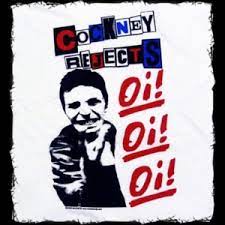
Take a look at any long-lived punk band and you'll usually see one of three patterns. They will remain relatively the same throughout their life, like the Ramones; they will gradually change within the punk genre over the years, like Agnostic Front; in some cases, however, they leave their punk roots and go exploring for a bit. The Cockney Rejects are one of those bands that fit into that third category, which, for the purposes of this article, I shall call the Punk Progression Paradigm.
This progression starts simply, the band is a group of young punk rockers, skinheads, or what have you. They release some albums, EPs, singles. Most of this early material sounds similar, it might vary a bit as they try to find their sound. Then something happens, maybe they get to a point where they realize they're getting repetitive, or a key member of the band leaves, or maybe they just want to reach a larger audience. Whatever the case, their sound changes significantly.
The second step in this progression is the release of an album that is more in line with a sound that is rising in popularity at the time. During the 1980s this would often be a post-punk or new wave sound, or hard rock and heavy metal was another popular alternative. This would last for a few albums and then, either by conflict within the band, or just never getting the new sound to really catch on, the band's momentum just peters out. They'll often go on hiatus, explore solo work, or just call it quits entirely.
The final stage is the return to form. The band comes back with a new album that has more in common with their earlier works than with their more recent offerings. Some old members may have returned to the line-up. Perhaps that old style they used to play is seeing a resurgence in popularity. Regardless of the reason, they return to that original style, older and wiser, and with that maturity reflected in their sound. The old energy isn't quite there, but the albums are enjoyable.
So let's take a step through the Reject's catalog and see how they followed this paradigm...
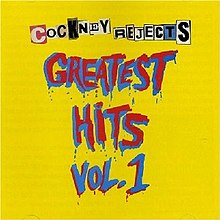 The Cockney Rejects first two albums are two volumes of The Cockney Rejects Greatest Hits. These are not "greatest hits" packages, though they do contain some previously issued singles, and are considered proper albums in their catalog. Both were released in 1980, and represent the early punk energy you'd expect from bands of that era. Which album is the better one is debatable, as they are both very similar, but whichever one you like better, they are both prime examples of early British street punk, and helped to coin the name of the Oi! subgenre. Both are full of raw power and energy and are obviously placed firmly in the first phase of the progression.
Their third album, The Power And The Glory is still a punk/Oi! album but you can hear the change begin. The energy level is toned down a bit and some hard rock elements were being introduced. While some opted to go in a more post-punk direction around that time, the Rejects weren't really that sort of band. This was music for folks who liked to go down the pub to watch the West Ham match, they wouldn't have related to music of a more experimental nature. While this album hinted at things to come, it was still a solid punk/Oi! album, though I would consider this to be the one that closed out that first stage.
The following year brought The Wild Ones. While their previous release was an Oi! record with hard rock influences, this was a hard rock album with some residual Oi! I can't pin down a particular style of hard rock or heavy metal they might have been going for, I'm not sure if they were even sure, but I hear some influences of bands like Judas Priest, Motörhead, AC/DC and the like. Apparently this was produced by a member of UFO, but I'm not familiar with that band, so I can't really say if that's an influence. So the Cockney Rejects were now officially a hard rock outfit. If people thought that was weird, wait'll they see what comes next.
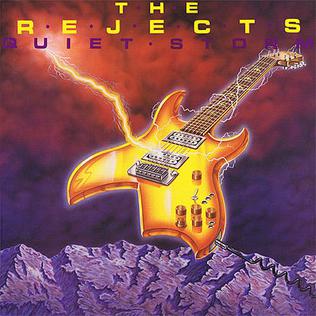 The Rejects, as was their name as printed on their 1984 album Quiet Storm, went into some very different territory. Where their previous album was a full on early 1980s rocker, this one takes us back to the 1970s with blues rock and arena rock inspired songs. I'm not sure why they would choose this type of music, as NWOBHM was pushing all of those older sounds aside. It seems like it didn't work out too well for them though, as this would be their last album for six years.
In 1990 the Cockney Rejects returned with a new album and their old name. Titled Lethal, this album picked up where The Wild Ones left off. This was the era of the West Coast style of "gritty" hard rock, and this was just that sort of album. The sound reminds me a lot of the TSOL albums from this era: Hit & Run and Strange Love, in both musical style and vocals. Incidentally, TSOL is another band that follows this progression paradigm, perhaps I'll do an article on them in the near future, but I digress. Lethal would be the last album of new material from the Cockney Rejects for twelve years.
When the Rejects returned in 2002 with their album Out Of The Gutter, they were a punk band again. Not the same punk band that people would remember from 1980, but definitely not the hard rock hair metal style band that they left off at in 1990. Often in a punk band's return-to-form stage, they bring together all their styles of music to a certain extent. This album was about a 50/50 mix of punk and hard rock, which is a good place to start over as you can appeal to your early fans as well as your more recent fans.
The mixture of styles continued into the next album, Unforgiven. I like this one better than the last, it's definitely more punk sounding. Specifically, I get a big Cook & Jones (Sex Pistols, The Professionals) vibe. Listen to the Sex Pistols songs that Cook & Jones sing on, like "Silly Thing" or "Here We Go Again" and you'll see what I mean.
Their last album to date, East End Babylon, is where they came home. This one was all punk rock. The closest to their early albums that they've been in thirty years. At this point in their careers, that's where they need to be. If a band is around for that long, especially if they've taken a hiatus or two, the fans who are still hanging on are the ones who remember them from the beginning. That's why this paradigm happens.
With this paradigm, you see a sort of life cycle for a punk band. They start out at home, leave to find themselves, then come back with the scars they got finding out that who they were at the beginning is who they really were all along. They're older and have changed a bit, but they're still the band you remember from way back when. Perhaps that fire they had in their eyes isn't as bright anymore, but when they need to, they can light it up again for a bit.